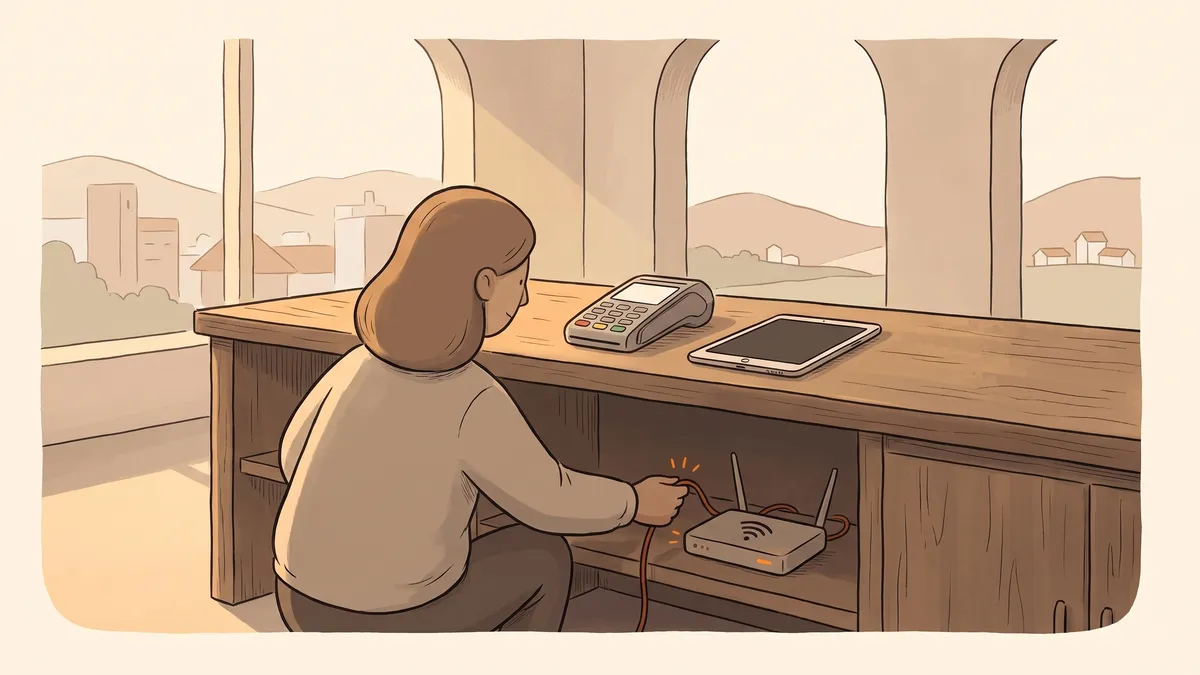
You know the spots. The back corner where the signal dies. The afternoon when everything slows to a crawl for no clear reason. The little box on the shelf you have learned to reboot when things get bad, the way you might thump an old television.
Most people treat unreliable Wi-Fi as a fact of life. It is not. When a network is built for the space it actually has to cover, it just works, quietly, everywhere, all day. If yours does not, the equipment is usually the reason.
The box from the electronics aisle was built for a living room
The all-in-one router most businesses start with was designed for a home: a handful of devices, a few rooms, one or two people streaming at night. It is inexpensive, and for a house it is fine.
A business asks far more of it. Staff laptops and phones, a point-of-sale system, a back-office computer, cameras, a printer or two, and every customer who connects while they wait. One small box, sitting in one spot, is asked to blanket a whole building and juggle all of it at once. So it does what it was never built to do, and it does it badly: the far corners get no signal, everything competes for the same crowded lane, and when it gets overwhelmed it drops connections or simply locks up.
Rebooting it helps for an hour because you have briefly cleared the jam. The jam comes back because nothing about the situation changed.
What reliable coverage actually takes
Good business Wi-Fi is less about one powerful device and more about the right pieces, placed on purpose.
Instead of a single box straining to reach everywhere, you use business-grade access points positioned around the space so coverage follows people as they move, from the front counter to the back room to the parking lot if you need it there. They are built to handle many devices at once without buckling. And because they are managed centrally, the network can be watched, tuned, and updated, so the slow problems get noticed before they become the afternoon everything grinds to a halt.
One consumer box for everything
- Built for a home, asked to cover a business
- Dead zones in the corners and far rooms
- Everything competes for one crowded connection
- A weekly reboot is part of the routine
A network built for the space
- Coverage that follows people across the whole building
- Equipment built to carry many devices at once
- Centrally managed, watched, and kept up to date
- Problems caught early, before they interrupt the day
A router you have to restart every week is not a quirk to live with. It is the clearest sign the equipment is past its limits or was never the right fit for the space. The reboot treats the symptom for an hour; the cause is still there.
The other half of the job: keeping the lanes separate
Reliable coverage solves the dropping and dead-zone problem. There is a second problem worth solving at the same time, which is who and what shares the network.
When your customers, your staff computers, your card reader, and your cameras are all on one flat network, a busy guest device can crowd out the work that matters, and a single weak link can reach far more than it should. The fix is to give each its own lane. We get into why that matters, and what it protects you from, in one password shouldn’t open your whole business.
It should be something you never think about
Wi-Fi is one of those things you should only notice when it is bad. Done right, it stops being a daily frustration and becomes part of the background, the way the lights and the water are. You walk to the far corner and you are still connected. The busy afternoon comes and the network does not flinch. Nobody reaches for the reboot.
That is how we set up and look after the networks for the businesses and towns we work with: the right equipment for the actual space, kept watched and current, so it stays reliable long after the install. It is one piece of managing the whole picture rather than a box you bought once and hoped about.
Tired of fighting your Wi-Fi? Get in touch and we’ll take a look at your space and what it would take to make the dead zones and daily reboots a thing of the past.